AI in technical interviews: where assistance ends and cheating begins
Draw a practical line between useful AI assistance and hidden delegation—and apply the same standard to candidates, interviewers, and hiring teams.
AI did not invent dishonesty in technical interviews. Candidates have always been able to memorize answers, receive help they do not disclose, exaggerate experience, or present someone else's work as their own. Interviewers have always been able to arrive unprepared, reuse questions they barely understand, or turn a hiring decision into a checklist without exercising much judgment.
AI makes both sides easier to scale.
A candidate can quietly receive an answer they cannot produce or defend. An interviewer can generate a convincing set of questions without understanding the role, the candidate, or the answers. In both cases, the conversation may look more capable than the person conducting it.
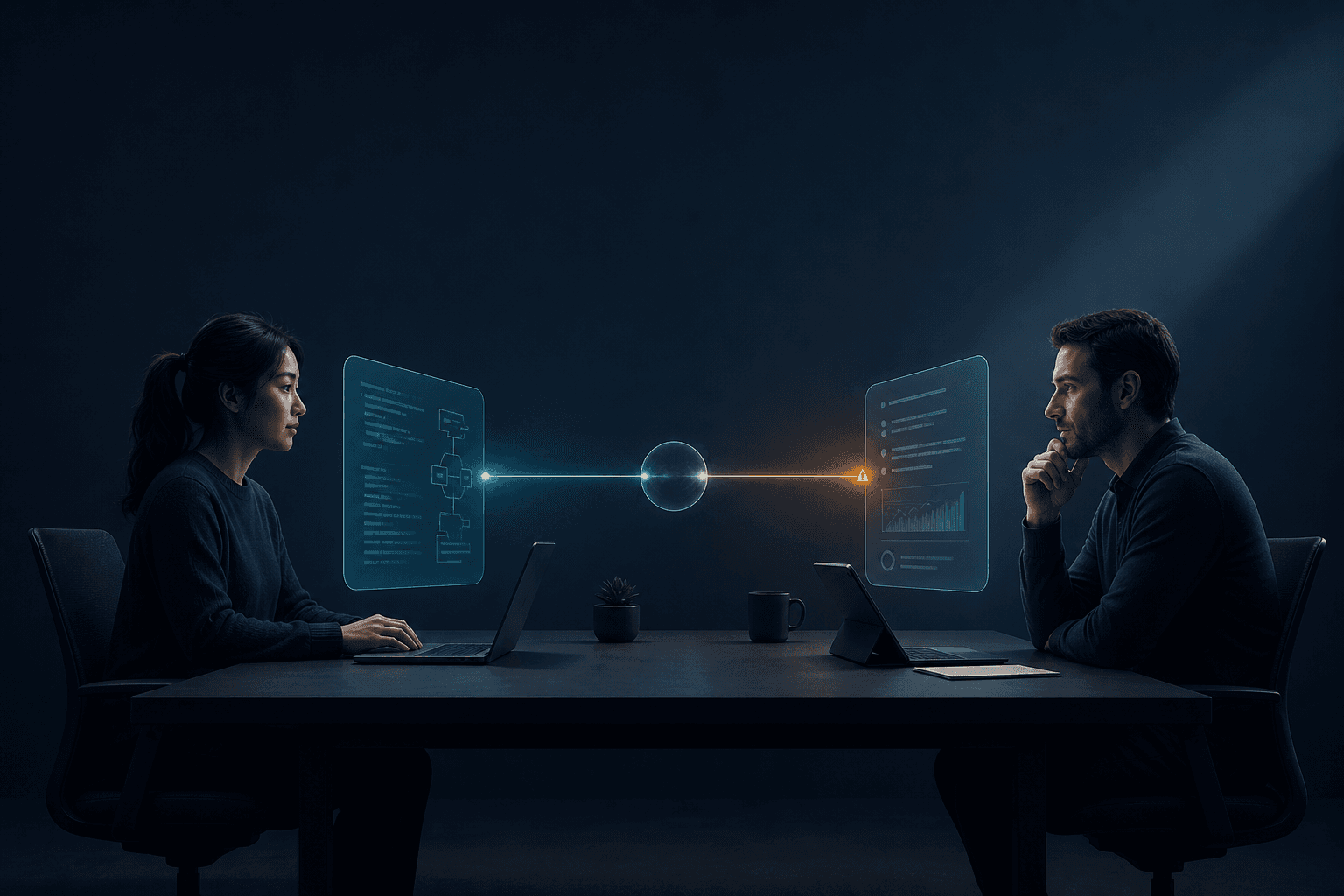
That is the useful distinction. The problem is not simply AI use. It is hidden delegation that creates a false impression of human capability or judgment.
Start with a clearer boundary
The same tool can be legitimate preparation, allowed assistance, or cheating depending on the stage and the expectations.
Using AI before an interview to identify weak areas, generate practice questions, challenge an explanation, or review a code sample is preparation. It is no more automatically dishonest than using documentation, a book, or another developer's feedback.
Using AI during an exercise can also be legitimate when the company explicitly allows it. Many developers work with AI-assisted tools in their actual jobs. An interview may reasonably test whether someone can give the tool good context, inspect the result, notice a bad assumption, and turn generated output into a sound engineering decision.
The boundary is crossed when assistance is hidden and the interview is designed to measure unaided work—or when generated reasoning is presented as if it belongs to the person in the room.
A useful test is:
If the other side knew exactly how the result was produced, would they still believe this interaction represented the capability being evaluated?
If the answer is no, the problem is not the existence of AI. It is the false signal.
What candidates still need to own
AI can produce a clean explanation or plausible implementation quickly. That does not mean the candidate owns it.
Ownership becomes visible when the interview moves away from the initial output. Can you:
- explain why the answer is appropriate for these requirements;
- identify its assumptions and failure modes;
- modify it when a constraint changes;
- debug it when the first version fails;
- compare it with a reasonable alternative;
- say what you do not know without asking the tool to manufacture certainty?
If you cannot do those things, the generated answer is covering the gap rather than helping you work through it.
This is why a hidden real-time answer feed is different from an allowed coding assistant. The first substitutes for the reasoning the interviewer believes they are observing. The second can become part of the work being assessed, provided the rules are clear and the candidate remains responsible for the result.
When the policy is unclear, ask before the exercise begins. "Are documentation and AI-assisted tools allowed during this stage?" is a professional question. It is better than guessing what the company considers acceptable and discovering that your assumption invalidated otherwise good work.
The clearest case: a hidden live answer feed
Some AI tools can listen to an interview through the microphone or system audio, transcribe the interviewer's question, and privately suggest an answer while the conversation is still happening. Some can also read a shared screen or coding exercise and continuously propose what the candidate should say or type next.
When an interview is intended to evaluate the candidate's own unaided reasoning and that assistance is not disclosed, this is cheating. It is not ordinary preparation, and it is not made honest because the candidate paraphrases the generated response instead of reading it word for word.
The false signal is the same: the interviewer believes they are observing how the candidate recalls, reasons, communicates, and responds under pressure. In reality, part of that performance belongs to a hidden system operating outside the agreed interview conditions.
There are legitimate exceptions. A company may deliberately run an AI-assisted exercise because those tools are part of the job. A candidate may use a disclosed accessibility accommodation. In either case, the assistance is known, the conditions are agreed, and the candidate can still be asked to explain and defend the result. The ethical difference does not come from the interface or the model. It comes from disclosure, permission, and ownership.
Hiring teams should resist turning this into a contest of surveillance. Looking away from the camera, pausing before an answer, typing during a call, or sounding unusually polished does not prove that someone is receiving hidden assistance. Accusing candidates from weak behavioral signals will punish thoughtful communication, nervousness, disability, and ordinary note-taking alongside actual misconduct.
A stronger interview makes borrowed reasoning difficult to hide without pretending that detection is perfect. Ask a responsive follow-up. Change a constraint. Request a concrete example. Introduce a failure and ask the candidate to diagnose it. Someone who owns the answer can usually work with it as the conversation changes; someone following an invisible script must keep waiting for the next script.
The same disclosure standard applies in the other direction. If a company uses AI to listen to the candidate, generate live follow-up questions, analyze behavior, or produce an interview score, the candidate should know. A silent evaluation system can misrepresent how much of the judgment belongs to the interviewer just as clearly as a silent answer system can misrepresent how much of the reasoning belongs to the candidate.
Interviewers can create false signals too
Trust does not flow only from candidate to company.
An interviewer can use AI to organize notes, draft a question from a real competency, or identify follow-up angles. That can improve preparation. But the interviewer must still understand what the question measures, recognize several valid approaches, and judge the candidate's reasoning in context.
Problems begin when the generated material substitutes for that responsibility.
The warning signs are familiar:
- questions are polished but disconnected from the role;
- the interviewer cannot clarify an ambiguous requirement;
- only one phrasing or implementation is treated as correct;
- follow-ups do not respond to what the candidate actually said;
- a summary or scorecard contains claims unsupported by the conversation;
- automated evaluation is treated as a verdict no human needs to defend.
That also creates a false signal. The candidate believes they are being evaluated by people who understand the work and have considered their evidence. If the process is mostly generated and no one takes ownership of the judgment, the company is misrepresenting the quality of its hiring process.
Efficiency does not remove accountability. If AI helps write the question or summarize the interview, a named human should still be able to explain why the evidence supports the decision.
Make the rules visible before the interview
Companies should not rely on candidates guessing an unwritten AI policy.
Each stage should state:
- whether AI tools are prohibited, optional, expected, or limited;
- which tools and resources are allowed;
- what must be disclosed;
- which capability the stage is intended to measure;
- how generated output will be discussed and evaluated.
The policy may differ by stage. A short fundamentals conversation may be intentionally unassisted. A practical implementation exercise may allow the same tools used on the job. A system design discussion may permit documentation while still requiring the candidate to make and defend the decisions.
That is not inconsistent. It is a better test design—as long as the candidate knows which mode they are entering.
Clear rules also reduce the temptation to build a surveillance contest. Trying to infer dishonesty from eye movement, typing rhythm, pauses, or an answer that sounds unusually polished will create false accusations and reward candidates who are merely better at appearing natural.
Design the interview so ownership becomes observable instead.
Test the reasoning after the output
Whether AI is allowed or not, static answers carry less signal than they once did. A copied answer, memorized answer, and genuinely understood answer can initially look very similar.
The difference appears through interaction.
After a candidate proposes a solution, change one meaningful constraint. Ask which assumption would fail first. Introduce a bug and ask how they would isolate it. Request a smaller version, a safer version, or a version suitable for a different scale. Ask what evidence would cause them to reverse the decision.
These are not trick questions. They resemble engineering work.
For example, if a candidate produces a plausible caching design, do not spend the remaining time trying to determine whether every sentence was generated. Ask how stale data affects the product, what invalidates an entry, how failure changes the behavior, and what they would measure after release. A candidate who owns the reasoning can work through the consequences. Someone borrowing the surface of an answer will usually struggle when the context moves.
The same standard should be applied to the interviewer. They should be able to explain why the follow-up matters, accept more than one defensible path, and distinguish a different judgment from a weak one.
Do not outsource your uncertainty
One of AI's most attractive features is its ability to turn uncertainty into fluent language. That is also one of its risks in an interview.
Candidates can start presenting confident answers before they have decided what they believe. Interviewers can turn incomplete notes into a polished evaluation that sounds more certain than the evidence deserves.
Both sides need to preserve honest uncertainty.
For a candidate, that may sound like:
"I have not operated this exact system, but I would begin by verifying these two assumptions. Given the current constraints, I would choose this approach because..."
For an interviewer, it may mean recording that the evidence was incomplete, asking another interviewer to test a specific area, or refusing to let an generated summary fill a gap in the conversation.
Uncertainty is not incompetence. Hidden uncertainty wrapped in authoritative language is far more dangerous.
A practical standard for candidates
Before using AI around an interview, ask four questions:
- Is it allowed at this stage? If the company has not said, ask.
- Am I using it to improve my work or to impersonate capability I do not have?
- Can I explain and change every important part of the result?
- Would I be comfortable describing this use to the interviewer?
Use AI aggressively in preparation if it helps you practise more honestly: ask it for follow-ups, make it challenge vague claims, request counterexamples, or use it to reveal where your explanation depends on memorized wording.
During the interview, follow the stated rules. When AI is allowed, make your judgment visible. Say what you accepted, what you rejected, what you verified, and where the tool's first suggestion was insufficient.
The goal is not to prove that you can produce text without assistance. It is to show which engineering capability remains yours when assistance is available.
A practical standard for hiring teams
Before adding AI to a hiring stage, ask the equivalent questions:
- Does the candidate know where and how AI is being used?
- Is the tool improving human judgment or quietly replacing it?
- Can the interviewer defend the question, evidence, and conclusion without pointing to the model?
- Would the process still feel fair if its operation were fully visible to the candidate?
Use AI to remove administrative friction, improve consistency, and explore stronger follow-ups. Do not use it to create the appearance of role knowledge the interview team does not possess. Do not let an automated score become more authoritative than the conversation it summarizes.
Most importantly, keep a human accountable for the decision.
Trust has to survive disclosure
Technical interviews have always involved imperfect signals. AI makes it easier for candidates and companies to polish those signals, repeat them at scale, and hide how much human thought sits behind them.
The answer is not to pretend the tools do not exist. It is to make the rules explicit, design conversations that reveal ownership, and hold both sides to the same standard.
Assistance is compatible with integrity. Hidden delegation is not.
A trustworthy interview is one where full disclosure would not change what either side believes happened—and where the important reasoning and final judgment still belong to the people in the room.
Human editorial direction
Aporeon Guides are written and reviewed to help developers prepare practical answers and decisions, not to reproduce documentation or manufacture search traffic. Read the editorial standards.